Custer High School
Class Of 1962
| ||||||||||
UPCOMING BIRTHDAYS

| • | Diana Lex (Hurley) 10/22 |
| • | Dean Schwarten 10/22 |
| • | Harold Meyer 10/24 |
| • | Marian Schopp (Bringe) 10/25 |
| • | Marilyn Griffith (Bauer) 11/2 |
| • | Bonnie Kluczny (Hayburn) 11/3 |
| • | Donald Luckow 11/4 |
| • | Judith McConnell (Anderson) 11/7 |
| • | Toni Rae Cera (Stockinger) 11/8 |
| • | Allan Le Pine 11/8 |
| • | Sandra Sleik (Yetman) 11/14 |
| • | Gisele Boerger (Holmquist) 11/16 |
| • | William Gregorius 11/16 |
| • | Judith Franzel (Clifton) 11/17 |
| • | Werner "Bernie" Raml 11/18 |
 |
PROFILE UPDATES
| • | Jim Cejka 10/15 |
| • | Gordon "Allen" Mitchell 5/9 |
| • | William Nelson 4/8 |
| • | Janis Thompson (Hume) 12/28 |
| • | Gary Ehn 11/18 |
| • | Wayne Reineck 10/14 |
| • | Coleen Kober (Marshall) 10/10 |
| • | Garry Sellers 10/6 |
| • | Terri Levenhagen (Hoornstra) 9/13 |
| • | John Krasnan 8/21 |
|
WHERE ARE THEY NOW

WHERE WE LIVE
Who lives where - click links below to find out.
9 live in Arizona
2 live in Arkansas
17 live in California
2 live in Colorado
1 lives in Connecticut
17 live in Florida
1 lives in Georgia
1 lives in Hawaii
3 live in Illinois
3 live in Indiana
2 live in Iowa
3 live in Kentucky
1 lives in Louisiana
1 lives in Maine
1 lives in Maryland
1 lives in Massachusetts
2 live in Michigan
5 live in Minnesota
1 lives in Missouri
1 lives in Montana
4 live in Nevada
1 lives in New York
3 live in North Carolina
1 lives in Oklahoma
4 live in Oregon
1 lives in Pennsylvania
1 lives in South Carolina
2 live in Tennessee
9 live in Texas
2 live in Virginia
5 live in Washington
163 live in Wisconsin
1 lives in Wyoming
172 location unknown

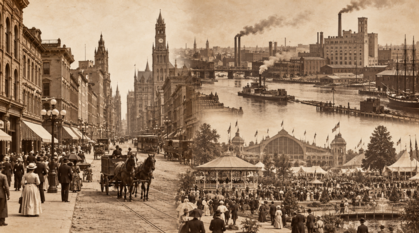
We’re now 64 years past our 1962 graduation. Go back 64 years before it, and we’re in 1898—where our time-traveling classmates are continuing their adventures around Milwaukee. The history is real. Our classmates’ involvement? We’ll take responsibility for that.
When Milwaukee’s State Fairgrounds Went to War

Tom Burger and Wayne Reineck time- travelers were among some 3,000 Wisconsin volunteers ordered to Camp Harvey—Milwaukee’s State Fairgrounds—after the destruction of the USS Maine in Havana Harbor helped send America to war with Spain. Their first enemy was the tent. Their regiment never reached Cuba.
Enjoying the spectacle is fellow 18-year-old volunteer Billy Mitchell, who actually trained there. Raised in a nearby 28-room mansion that still stands, Billy later championed military airpower, got himself court-martialed for criticizing his superiors, and was awarded a Congressional Gold Medal—ten years after he died. Milwaukee named its airport after him.
Billy would spend much of his career trying to get things into the air. Tom and Wayne were still trying to keep their tent on the ground.
Sick Call: The Line Forms Here
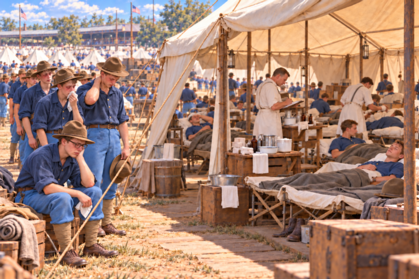
At Camp Harvey, the sick-call line was already long. In the Spanish-American War, disease killed seven times as many soldiers as combat. Billy Mitchell escaped after just 25 days, thanks to a commission—and a senator for a father. If they'd waited another 60 years, Mama Mia's garlic bread would have been just two blocks away. That could cure anything!
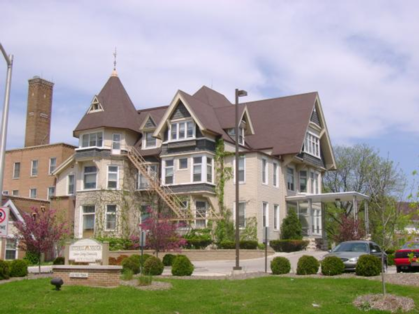
Meadowmere, Billy Mitchell’s 28-room boyhood home, still stands at 5301 W. Lincoln Avenue in West Allis—one survivor of 1898 that did manage to stay on the ground. Photograph: Wisconsin Historical Society
Milwaukee Goes Wild West

Roger Strehlow, Carol Albers, John Ruhland, Karen Krause and Warren DeSmidt are watching Buffalo Bill’s Wild West roll into Milwaukee in July 1898—with more than 50 railroad cars, nearly 500 performers and workers, hundreds of horses, its own electric plant and grandstands for 20,000.
The parade passed Third and Kilbourn, outside the Romadka Bros. building, once home to the country’s largest trunk manufacturer. The Hyatt Regency stands there today.
Cowboys, Native American riders, cavalrymen, Cossacks and Arabs rode by—the United Nations on horseback, with considerably more manure. Native performers were paid and could bring their families, but were usually cast as villains. Annie Oakley fared better: only Buffalo Bill earned more.
Shot in Milwaukee, Teddy Kept Talking

Yes, Theodore Roosevelt really was the target of an assassination attempt in downtown Milwaukee—right where our time-traveling classmates watched Buffalo Bill’s parade in 1898.
By 1912, the former Romadka building at Third and Kilbourn had been remodeled into the upscale Hotel Gilpatrick. Roosevelt had just left the hotel when a gunman shot him at close range as his bodyguard lunged for the shooter. The bullet passed through his steel eyeglass case and folded 50-page speech bulging from his breast pocket before lodging in his chest.
Roosevelt decided that if he could still breathe, he could still talk. He went to the nearby Milwaukee Auditorium and spoke for almost 90 minutes before finally going to the hospital.
For once, a long political speech saved a life.
Our classmates’ time-traveling tales continue, with more Milwaukee history waiting around the corner.
- - - - - - - -
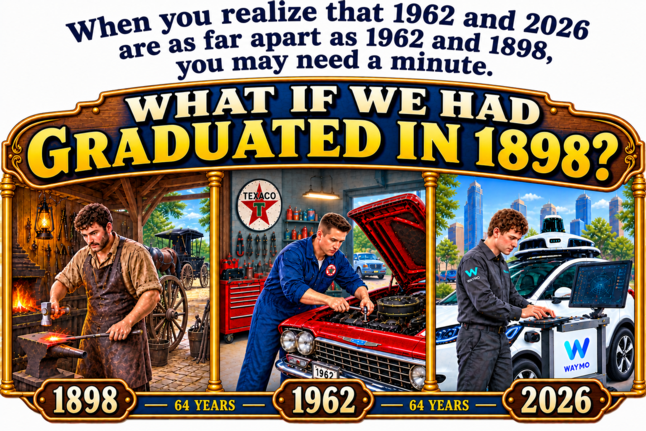
*For this journey we are traveling back to 1898. None of us were married back then therefore we're using classmates' maiden names. Our apologies to the ladies who have long ago thought of themselves by that name.
- - - - - - - - - - -
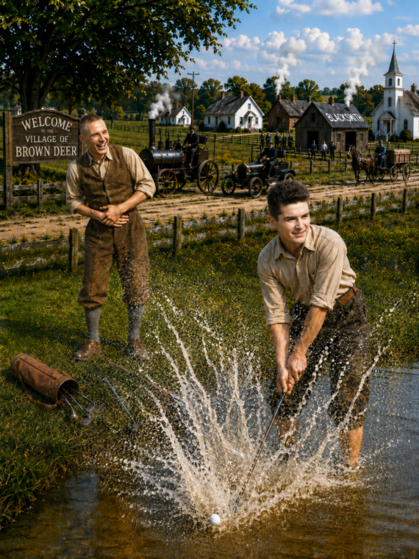
1898 Golf — Wayne Reineck and Bernie Raml - Legend says a brown deer once crashed a saloon card game, giving the area its name. Bernie crashed a water hazard—even though the golf course was still decades away. Bernie claims he has always been ahead of his time! Wayne claims he's all wet!!
- - - - - - - - -
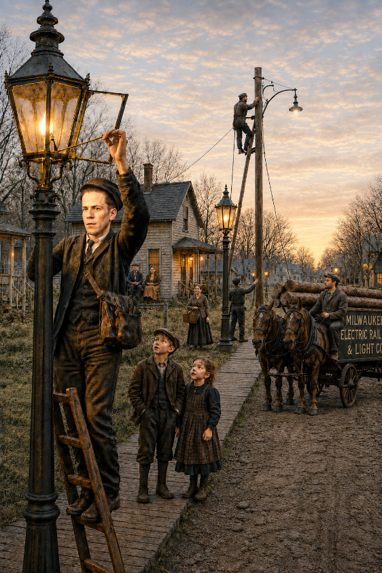
1898 Lamplighter – Dean Schwarten - Milwaukee Electric Railway & Light had already absorbed the local Edison company. Electricity was taking over Milwaukee — and Dean’s lamplighter job was living on borrowed time.
- - - - - - - - -
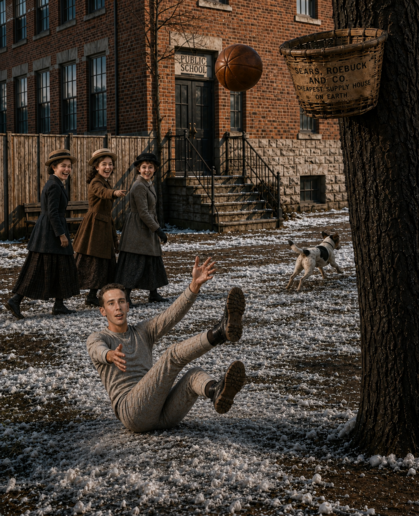
1898 — Basketball – Ron Willman – Basketball was only seven years old, and the jump shot was still decades away. Ron appears to be experimenting with an intermediate step—the slip-and-fling shot. History declined to preserve it, but Ron spent a lifetime inadvertently perfecting it.
- - - - - -
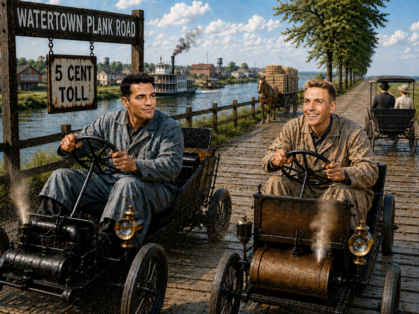
1898 Watertown Plank Road Drag Racers - John Leopold and John Gilbert - Completed in 1853, the 58-mile Watertown Plank Road was a toll route carrying farm goods to Milwaukee and merchandise back. It was literally made out of planks. The two Johns found another use for it, inventing drag racing in their home-built machines at a blistering 10 mph. John G. supplied the laughs; John L. became one of the first among his classmates to own a car, which did nothing to hurt his popularity.
- - - - - - -
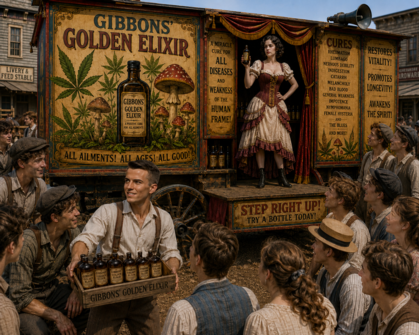
1898 Snake-Oil-Salesman - Jim Gibbons and Pam Seibert - In 1898, patent-medicine hucksters could — and did — promise a cure for almost anything. Jim supplied the elixir and Pam helped draw the crowd. Jim eventually traded miracle cures for cultivating herbs and competitive running, which became lifelong pursuits. Pam switched to miracles from a Higher Authority.
- - - - - - - - -
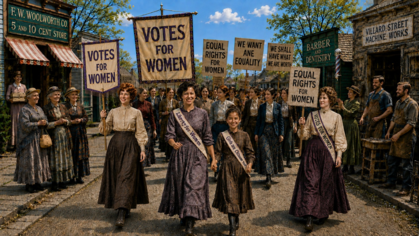
1898 Women's Sufferage — Marian Schopf, Kathy Tabat and Terry Levenhagen - 1898 — Wisconsin women had been fighting for the vote for nearly 30 years, but Milwaukee was tough territory. Suffrage was closely associated with temperance, and Milwaukee's large German population wasn't particularly enthusiastic about a movement associated with taking away their beer. Our classmates march down Villard Street—named for Henry Villard, who had come to Milwaukee as a young man to sell books to German immigrants. He spent more than he sold, left town, and later made his fortune in railroads
- - - - - - - - -
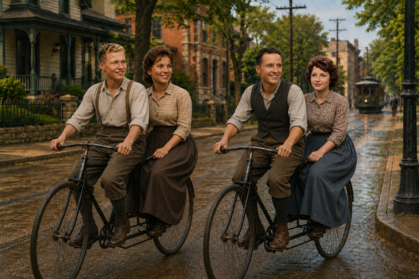
1898 Bike riding – Larry Scholl, Sue Loch, Bill Gregorius and Pat McCarthy — Milwaukee had electric streetcars for 8 years and was caught up in the bicycle craze. Teenagers William Harley and Arthur Davidson were already Milwaukee bicycle enthusiasts; three years later they began experimenting with putting an engine on one. Larry, Sue, Bill and Pat stuck with pedal power—and tried to keep their wheels out of the streetcar tracks.
- - - - - - - - -
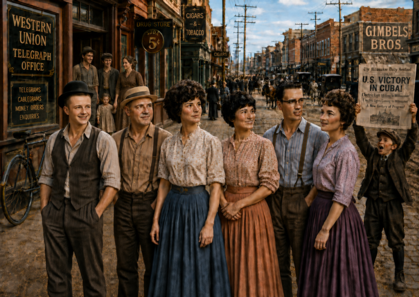
1898 Western Union Office - Roger Pederson, Jerry Coutley, Leslie Werner, Bev Barry, Jim Cejka and Marilyn Griffith - In 1898, Western Union was the smartphone of its day—texting service, banking app, newsroom, shopping link and social network all in one. Our classmates gathered to send messages, wire money, order goods, await news from Cuba and learn everyone else’s business while they waited.
- - - - - - - - - - -
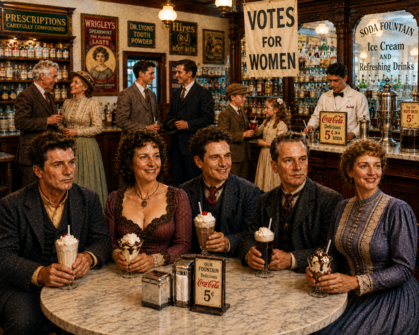
1898 Drug Store/Soda Fountain - John Stanelle, Jan Bauernfeind, Alan Close, Gary Ehn and Janis Schendel - The soda fountain was a big draw for drugstores, serving Coca-Cola, root beer, ice cream and other treats. But in 1898, Coca-Cola still contained cocaine, patent medicines could contain morphine or opium, and Bayer had just introduced heroin as a cough medicine. The kids wisely stuck with the ice cream.
- - - - - - - - - - -
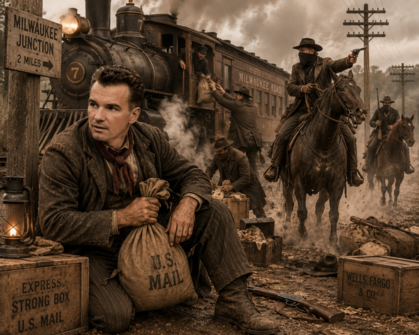
1898 Train Robbers— Garry Sellers – In 1898 train robbery was near its peak, with mail and express cars tempting targets for outlaws. Wells Fargo was a favorite, and the Pinkertons were seldom far behind. Five years later, Edison released The Great Train Robbery, one of the first great movie hits. Was Garry really a thief—or just auditioning five years early for a part in Edison’s movie? The movie would be one of the Best Sellers!
- - - - - - - - - -
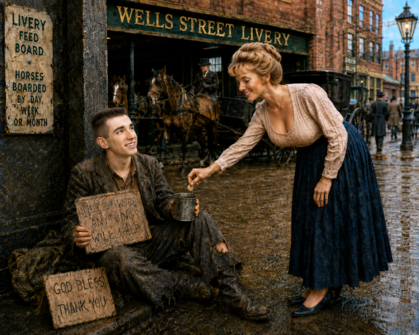
1898 Panhandling — Gordy Sauer and Judy Blaske - Wells Street was named for Daniel Wells, reputedly Wisconsin’s richest man, while livery stables were the parking garages and rental counters of his day. Gibbons’ Excelsior left Gordy at the opposite end of the financial spectrum. Judy Blaske took pity on him—never imagining Gordy would spend his entire life unable to get away from drugs.
- - - - - - - -
1898 to 1962 to 2026 - We never walked Villard Avenue in 1898, dodged streetcars on bicycles, raced homemade cars down Watertown Plank Road or gathered at Western Union for the latest news. But for a little while, it was fun imagining that we did.
And perhaps that’s the advantage of reaching this age: we have enough memories to treasure the past—and enough imagination to remember things that never happened.